Quantitative Research & Data Science
About
Passionate about quant finance.
I am a Computer Science undergraduate at IIT Mandi with a strong foundation in C++, Python, and Data Structures & Algorithms. My work spans Machine Learning, Deep Learning, and Vision-Language Models, with hands-on experience in medical imaging, audio anti-spoofing, and quantitative finance. I enjoy solving complex problems—whether optimizing algorithms, building models, or analyzing datasets—and I am deeply interested in backtesting, risk-return analysis, portfolio management, and the applications of AI in decision-making. I am always eager to learn, collaborate, and apply my skills to impactful challenges across tech and finance.
8+
Projects
2
Research
7.42
CGPA
Education
Degrees, scores & relevant coursework
Indian Institute of Technology, Mandi
7.42 / 10
Gujarat Secondary & Higher Secondary Education Board (GSEB)
96.06%
Gujarat Secondary & Higher Secondary Education Board (GSEB)
99.73%
Experience
Industry & professional roles
HDFC Asset Management Company Limited
Projects
Independent & group project contributions
Technologies: Alpha · Statistical Modelling · Factor Research
Technologies: REST API, Dart, Flutter, MongoDB
Technologies: LSTM, CNN, LRCN, OpenCV, ReactJS
A responsive web application designed to enhance public safety by providing real-time alerts based on the user's current location. The system classifies alerts into three severity levels and dynamically adjusts based on disaster type and duration.
Technologies: JavaScript, JSX, Tailwind CSS
Technologies: CLIP-ViT-L/14, Resnet50, CNN, Fine-Tuning, LSTM, Javascript, FastAPI
This project is an interactive implementation of the classic Stone-Paper-Scissors game using computer vision and Python. The system detects the player's hand gesture in real time using OpenCV and CVZone, classifies it as Stone, Paper, or Scissors, and pits it against the computer's randomly selected move. The game then calculates the result and updates the score dynamically.
This project demonstrates the integration of real-time image processing, gesture recognition, and basic game logic, providing an engaging and educational example of how AI and CV can be used to bring traditional games to life.
Technologies Used: Python, OpenCV, CVZone, MediaPipe (optional), NumPy
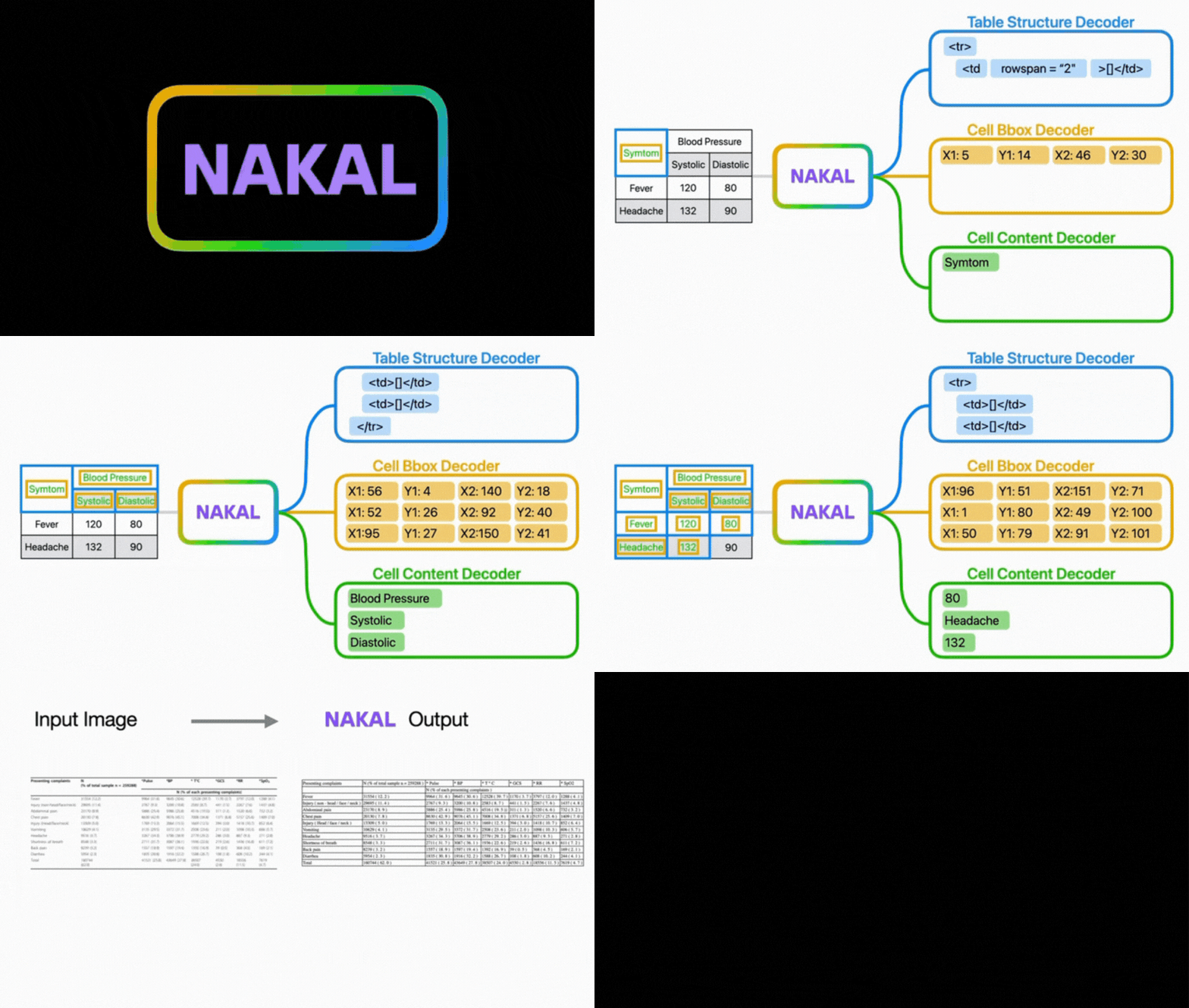
A novel framework designed to streamline and unify the process of table recognition (TR) by combining a task-agnostic architecture, a unified training objective, and a consistent training paradigm.
Technologies: PyTorch, torchvision, tokenizers, PIL, BeautifulSoup, Matplotlib, IPython, HTML, Python
Research
Undergraduate research at IIT Mandi
Undergraduate Researcher · IIT Mandi — Prof. Dr. Padmanabhan
In this research, we investigated how to enhance the explainability, clinical trust, and reasoning ability of Vision-Language Models (VLMs) in medical imaging applications—particularly for tasks like chest X-ray interpretation and medical visual question answering. We focused on integrating both explainability techniques and Chain-of-Thought (CoT) prompting to address the growing need for transparent and reliable AI systems in healthcare.
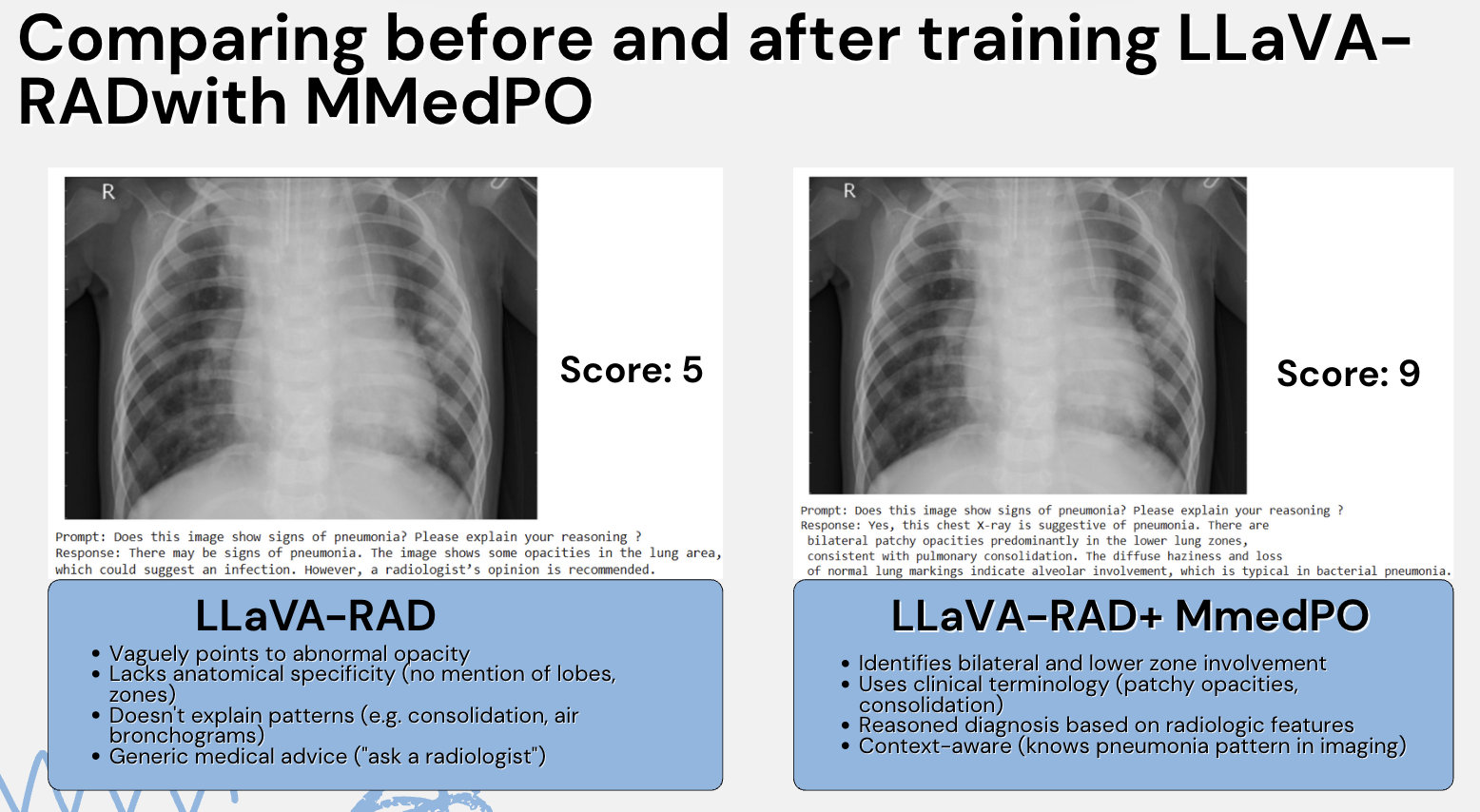
To improve interpretability, we leveraged LLaVA-Rad, a vision-language model tailored for radiology, and augmented it with Chain-of-Thought prompting. This allowed the model to generate intermediate reasoning steps while producing diagnostic reports, enhancing both logical structure and factual correctness. The step-by-step reasoning closely resembled the diagnostic thought process used by radiologists, making the AI's predictions more transparent and trustworthy. (Paper)
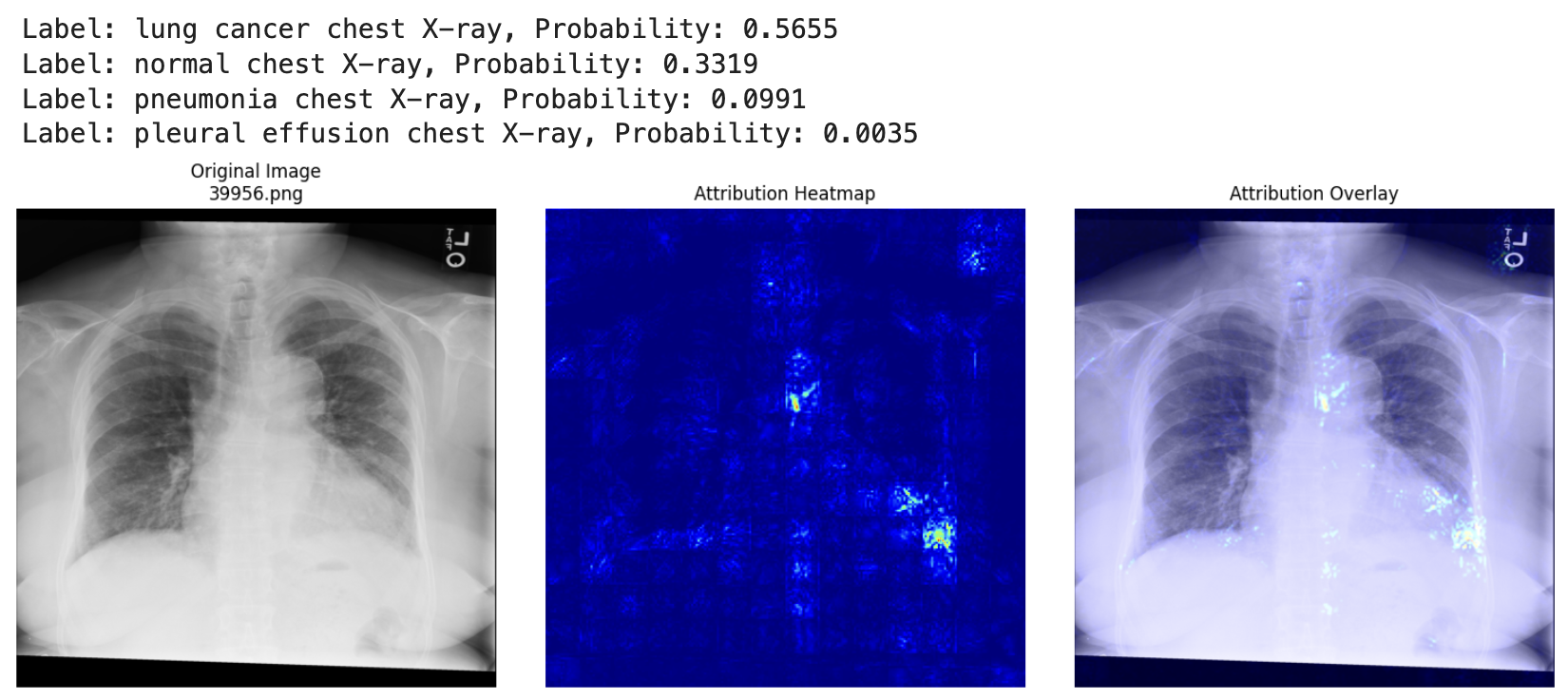
In parallel, we explored explainability in the multimodal BioMedCLIP model using Integrated Gradients, a gradient-based attribution method. By applying this technique, we were able to visualize which specific regions in chest X-rays contributed most to the model's predictions. These visual explanations aligned well with expert annotations, allowing clinicians to better understand the model's decision-making process and increasing its usability in real-world scenarios. (Paper)
To further align VLM behavior with clinical standards, we developed MMedPO (Multimodal Medical Preference Optimization)—a novel training pipeline that fine-tunes models based on clinically-aware preference pairs. We curated two types of data: text-based pairs created by introducing factual hallucinations via GPT-4, and image-based pairs generated by injecting noise into lesion areas. These preference datasets were scored for clinical relevance using collaborative setups (for text) and visual heatmaps (for images). During fine-tuning, we used normalized clinical relevance scores as weights, giving higher influence to examples deemed more clinically important. This approach allowed the model to prioritize learning from data that truly matters in a medical context. (Paper)
Skills
Tools & technologies I work with
Achievements
Certifications and competition highlights
• JEE Advanced: AIR 2,798
• JEE Mains: AIR 7,826 · 99.18 percentile
• Silver Medal - Top 3% Global Ranking
• Placed 150th out of over 5000 teams worldwide
• Competed in the highly competitive LLM Detect AI-Generated Text challenge
🥇 1st in D.I.S.R.U.P. – Case Study Innovation Challenge by E-Cell, IIT Mandi
Completed a simulation focused on quantitative research methods:
Leadership
Campus leadership and extracurriculars
End-to-end planning, coordination and execution of college cultural events.
• Coordinator of the IIT Mandi Lawn Tennis Club
• Represented IIT Mandi in the Inter-IIT Sport Meet
• Core Team Member for Planning and Management Team
• Contributed to the organization and execution of the largest cultural fest in the Himalayas
Contact
Reach out for collaborations or opportunities